PoppyMeze

Showing posts with label corruption. Show all posts

Thursday, 29 November 2012

Jeremy Bamber's latest action against conviction fails

Jeremy Bamber's latest action against conviction fails


Jeremy Bamber, photographed in 2010. Copyright: Andrew Hunter - Jeremy Bamber Campaign Jeremy Bamber's appeal was heard by two High Court judges


Related Stories


Killer Jeremy Bamber has failed in his latest High Court action to overturn a conviction for murdering five relatives 27 years ago in Essex.

Two judges in London rejected a judicial review application.

Bamber challenged a refusal by the Criminal Cases Review Commission (CCRC) to refer his case back to the Court of Appeal as a miscarriage of justice.

The CCRC, an independent body which investigates possible miscarriages, rejected Bamber's last appeal in April.

The decision on Thursday follows a single judge rejecting Bamber's application for permission to seek judicial review of the CCRC's decision after he studied the case papers in private.
Complex investigation
Bamber made a renewed application dealt with by Sir John Thomas, president of the Queen's Bench Division, and Mr Justice Globe.

Announcing the decision, Sir John said that having looked at the approach taken by the CCRC in the case he could not see "any way" in which a challenge could be made to the decision reached.

"It seems to me that a challenge is impossible to mount," he said.

The 51-year-old who is serving a whole-life term for the 1985 killings at a remote Essex farmhouse, has always protested his innocence.

In April, the CCRC said that despite a lengthy and complex investigation, it had not "identified any evidence or legal argument that it considers capable of raising a real possibility that the Court of Appeal would quash the convictions".

Bamber and two other killers have also started an appeal in the European Court of Human Rights against spending the rest of their lives in prison, claiming a breach of human rights.

Read Jeremy's response: http://jeremybamber.blogspot.co.uk/2012/11/uk-high-court-ruling-29th-november-2012.html


Saturday, 26 May 2012

Jeremy Bamber: How Police and Scientists Colluded....


To corrupt evidence.....

A)     In 1991, the City of London Police (COLP) were requested by JEREMY BAMBER to investigate the following issues:
‘Allegation One’: that there was no Exhibit Label for the sound moderator SBJ/1 from the original Police investigation, case number SC/688/85, when it was tendered in Court.
‘Allegation Five’: that Essex Police failed to investigate whether the sound moderator tendered in evidence at trial was the moderator bought for the murder weapon.
B)     On completion of the COLP enquiry two reports were produced. The published report concluded there was no case to answer to any of the complaints made by JEREMY BAMBER against Essex Police.  While the undisclosed confidential report found as fact that fabricated evidence had been adduced to impugn the credibility of Jeremy Bamber thus resulting in a guilty verdict at his trial in 1986.

The Evidence

1)   That an Essex Police Officer, probably DS 21 Stanley Brian Jones, seized a sound moderator SBJ/1 from the gun cupboard at White House Farm (WHF) on 7th August 1985.
2)      Indeed this is corroborated by Assistant Chief Constable (ACC) PETER SIMPSON stating in a press conference and reported in ‘The Echo’ dated 17th September 1985,
‘A silencer was found at the White House Farm on the day of the killings, but this does not have to mean anything suspicious.’ (See Material Exhibits File News clippings)
3)      And yet in a letter, dated 18th July 2002, from the Crown Prosecution Service (CPS) to Glaisyers Solicitors, PAUL CLOSE states that the beginning of the audio tape in question as to the above interview has a considerable section of the tape missing, when Essex Police disclosed it, (see Letter To Ewen Smith from CPS)
4)      The beginning of the interview would have evidenced that the sound moderator SBJ/1 was in fact seized on the 7th August 1985, which would have impugned the Crown’s case against JEREMY BAMBER at trial and appeal.
5)      Other documents that evidence the above allegations will be identified throughout this statement using the ‘HOLMES 2’ computer reference numbers from ‘ACCOUNT A 49.’
6)      It is fact that COLP interviewed Scenes of Crime Officer (SOCO) DS 219 DAVIDSON on 3rd October 1991, (HOLMES 76/174).  In the prĂ©cis of his statement at paragraph 17 he asserts that on the 9th August 1985, he was tasked with examining a number of objects including a sound moderator, (SBJ/1).
7)      On the 13th August 1985, DI RON COOK submitted this sound moderator SBJ/1, to Huntingdon Forensic Laboratory for examination by scientists, GLYNNIS HOWARD and LESLIE TUCKER, (see HOLMES 67/319 – GLYNNIS HOWARD statement 1st August 1991).          
8)      See the HOLAB 3, Submission of Articles for Examination Forms, dated 13th August 1985, (See Holab Forms 1,2,3,4,5) reference the sound moderator, ‘Item 22’ and ‘Item 23’, ‘SBJ/1,’ ‘DB/1,’ and ‘DRB/1,’ with the police investigation case number as ‘SC/688/85.’
9)      GLYNNIS HOWARD’S witness statement for the 13th November 1985, details that she tested blood on the inside and outside of the sound moderator DRB/1, and in both cases the blood was found to be of human origin, (Holmes 8/224)
While a letter from PETER WINGAD to DR, SCAPLEHORN states, ‘There was no record of blood being seen on the outside of the sound moderator,’ (see HOLMES 78/24). PETER WINGAD wrote this letter in his capacity as Head of the Forensic Laboratory.  While GLYNNIS HOWARD simply stated in Court at trial, that she had found blood on the outside of the sound moderator, (see GLYNNIS HOWARD’S Trial Transcript), therefore lack of corroboration is in issue.
10)  LESLIE TUCKER states in her 1st August 1991 testimony to COLP that she assisted GLYNNIS HOWARD on the 13th August 1985, (see HOLMES 67/321). Indeed, LESLIE TUCKER took notes and made a diagram of SBJ/1, (EXHIBIT REF GH/1).
In her testimony she states,
‘GH/1 has other notes upon it not made by me. These appear to be made by JOHN HAYWARD and ANDREW PALMER. These notes were not made on 13th August 1985. I am not aware of when they were added.’
11)  Four signatures appear on the General Examination Record made at Bench 4 on the 13th August 1985, they are LESLIE TUCKER, GLYNNIS HOWARD, MALCOLM FLETCHER and JOHN HAYWARD.  However, the General Examination Record does not corroborate that of the original sound moderator seized SBJ/1, because this document, the one bearing all four signatures refers to the forensic reference number as DB/1. It can now be evidenced that this reference did not in fact exist until 17th October 1985.  Thus the General Examination Record cannot be the original one created by LESLIE TUCKER on 13th August 1985, (see GENERAL EXAMINATION RECORD DB/1).
12)  The original sound moderator first discovered was assigned the reference number SBJ/1 on the 13th August 1985.  A Memo from  DI COOK to MALCOLM FLETCHER states,
‘Change sound moderators number to DB/1,’ (see HOLMES 67/241 MEMO dated 17th October 1985).
13)  GLYNNIS HOWARD testified to COLP in her witness statement dated 10th July 1991,
‘I did not have any further contact with DI COOK on the matter, or with Essex Police due to my sick leave,’ (see HOLMES 67/318).
14)  This is corroborated in a report by DR. WINGAD attached to a Memo from  DR. THOMPSON  to  DR. CLARKE  which clearly states,
‘To complicate the issue GLYNNIS HOWARD has been on long-term sick leave since January of this year,’ (see HOLMES 87/3).
15)  How is it that GLYNNIS HOWARD has signed a General Examination Record for a sound moderator DB/1 on the 13th August 1985, when the General Examination Record she signed was in fact referenced SBJ/1?(see paragraph 8).
16)  Furthermore, GLYNNIS HOWARD asserted in her testimony to COLP dated 1st August 1991 that when she examined SBJ/1 on the 13th August 1985, she discovered five stains on the sound moderator, (see HOLMES 67/319).  Four of these stains proved to positively identify human blood, while she tested a fifth stain on the flat surface on the muzzle end of the sound moderator, and identified this as a smear of red paint.
17)  GLYNNIS HOWARD failed to record her discovery of a smear of red paint on the end of the sound moderator in her Memo to DI COOK, dated 14th August 1985, or indeed in her numerous pre-trial witness statements and during her trial testimony.  It was not until 1991 that GLYNNIS HOWARD asserted this relevant discovery, in view of the facts turning on there being a fight in the kitchen at WHF, scraping the mantel shelf around the Aga. (See Holmes 67.318)
18)  Indeed, LESLIE TUCKER corroborates this as she has drawn a smear of red paint on the end of the sound moderator at the 9 o’clock position, (see EXHIBIT GH/1).  Thus it is relevant that on the General Examination Record depicting DB/1 and not SBJ/1, as the sound moderator in issue, the identifying smear of red paint is not recorded.
19)  The existence of this smear and it being deemed at the time materially relevant by the scientists is corroborated by JOHN HAYWARD in his hand written witness statement signed 8th November 1985, where he asserts that he examined SBJ/1 and that,
‘There is a smear of red paint at the muzzle end of the sound moderator,’ (see HOLMES 67/100 PDF page 7).
20)  Indeed JOHN HAYWARD took it upon himself to take a number of photographic images of the sound moderator SBJ/1, when he examined and dismantled it on the 12th September 1985.  These images are referred to as reference JH/1. See also document 80/10 reference 24J – 6 X Photo albums of silencers, and 24w – 7 X albums of photographs re silencer.
21)  Moreover, BRIAN ELLIOT was shown these photographs by COLP, (see BRIAN ELLIOT’S witness statement dated 3rd October 1991, HOLMES 67/322).  These images taken on the 12th September 1985 that are undeniably relevant evidence have never been tendered to the Defence in any event.  Similarly those photographs of silencers mentioned in document 80/10 remain undisclosed.
22)  In 2002, a third Police enquiry was undertaken to investigate the actions of Essex Police in the STOKENCHURCH enquiry.  A number of issues were found as fact.
23)  Action Number A204 states:
‘Examine paint on moderator to establish if there is paint thereon.’
‘FSS to examine paint stain (one) on moderator to establish if there are any blood stains underneath the paint marks.’
Result, 20/02/02:
‘The underside of the paint and the exposed area left on the moderator were tested for the presence of blood. The results were negative.’
24)  In 2002, STOKENCHURCH asked the FSS to examine sound moderator SBJ/1 that had a smear of red paint on the flat surface of the muzzle end.  Sound moderator DB/1 had been found as fact to have numerous red paint flakes impacted upon the knurled pattern, and no smear of red paint on the end of the flat surface, thereby establishing the difference between SBJ/1 and DB/1.
25)  COLP misled the Home Secretary at the time, in their published report submitted to him where they state,
‘That the sound moderator should have been photographed at the earliest opportunity.  Unfortunately this did not happen.  The earliest photographs taken of the sound moderator were taken on the 11th November 1985,’ (see COLP Report, paragraph 2/57). It can now be evidenced that this statement lacks credibility.
26)  MALCOLM FLETCHER was sent a number of photographs taken of the dismantled sound moderator by DI RON COOK, (see HOLMES 78/14).  These images had been taken by DI RON COOK at Chelmsford HQ Scenes of Crime Department on 21st August 1985, (see Holmes 8/215 DI RON COOK’S 25th September 1991 Witness Statement PDF page 33).
27)  It remains to be disclosed whether JOHN HAYWARD was aware when he examined SBJ/1 on 12th September 1985, that SBJ/1 had been dismantled in the first instance and had its baffle plates spread out upon a work bench where a blood stained rifle had been placed for convenience at the same time, possibly corrupting its evidential integrity.
28)  JOHN HAYWARD stated that he discovered a single flake of blood inside the sound moderator that he used in all his blood grouping tests, the question remains was he aware of the images that MALCOLM FLETCHER had in his possession as to the real possibility of contamination of SBJ/1 by the rifle when he examined it? (see HOLMES 78/14)
29)  Both JOHN HAYWARD and GLYNNIS HOWARD gave testimony as expert witnesses at trial.  They stated that they had screened the blood stains discovered on the sound moderator SBJ/1, to discern whether they were of human or animal origin.  The Jury were instructed by the two of them, that the blood tested did not originate from an animal but was in fact human.
30)  JOHN HAYWARD and GLYNNIS HOWARD failed to inform the Jury that they in fact screened the blood for two types of animal – dog and hen, (see HOLMES 12/194 PDF page 5) but the .22 rifle in issue (Exhibit DRH/15), was used to shoot rabbits, foxes and rats.  No evidence has been submitted to Huntingdon Forensic Laboratory to suggest that the sound moderator was ever used to shoot hens or dogs.  Why then select these two animal types as possible sources of the blood staining on the sound moderator SBJ/1? Indeed, why did JOHN HAYWARD and GLYNNIS HOWARD fail to inform the Jury that they had not tested the blood for obvious farm pests such as foxes, rabbits and rats but instead for hens and dogs?
31)  In 1986, on the basis of their expert testimony the Jury were led to believe that all types of animal screening had been undertaken, with a negative result, thus their credibility is in issue.
32)  Had it been brought to the Jury’s attention that the sound moderator could well have been contaminated with rabbit blood, then the Defence would have been able to rebut the prosecution’s proposition and illustrate that the positive result for AK/1 an enzyme attributed to Sheila Caffell, as asserted by JOHN HAYWARD, could also be attributed to the AK/1 enzyme found in all rabbit blood (see R-10).
33)  Moreover, on the 25th September 1985, BRIAN ELLIOT was prima facie given ‘SBJ/1’ to examine including the smear of red paint on the flat surface on the muzzle end, as discovered by GLYNNIS HOWARD and JOHN HAYWARD, (see HOLMES 67/319, HOLMES 67/100).
34)  BRIAN ELLIOT instead found a large quantity of red paint flakes impacted into the knurled end of the sound moderator, and no smear of red paint adhering to the surface of the flat end piece.  At the time BRIAN ELLIOT believed he was examining SBJ/1 due to its packaging and labelling, however this sound moderator was in fact DB/1.  This fact can be corroborated by BRIAN ELLIOT’S realisation in 1991 when he was shown JOHN HAYWARD’S photographs by COLP of SBJ/1, (see HOLMES 67/322, statement dated 3rd October 1991).
35)  Indeed, the sound moderator in photos JH/1 had blood in the dips and the grooves of its knurled pattern (see GLYNNIS HOWARD’S Trial Transcript).  These photographs had none of the twenty-five plus red paint flakes that BRIAN ELLIOT found in the dips and grooves of the knurl, and as evidenced in his trial testimony he found no blood in the sound moderator’s knurl (see BRIAN ELLIOT’S Trial Transcript).
36)  The diagrams drawn by BRIAN ELLIOT and LOUISE FLOAT on the 25th September 1985 shows that the sound moderator had a large piece of sticky tape adhering to it that was not present when JOHN  HAYWARD examined it, and then photographed it on 12th September 1985, (see HOLMES 67/193).
37)  It is fact that the sound moderator SBJ/1, also had a white film of super glue covering its outer surface owing to the fingerprinting process undertaken on the 15th August 1985.
38)  But DB/1, the sound moderator examined by BRIAN ELLIOT and LOUISE FLOAT did not have such a white film on its outer surface.
39)  Indeed DB/1 was found in the same gun cupboard as SBJ/1 by DAVID BOUTFLOUR on the 10th August 1985.  It then remained in a card board box at his sister, ANN EATON’S house until 11th September 1985, (see P35).  It was then collected by DC OAKEY on 11th September 1985 and handed to DCI WRIGHT SOC Chelmsford.
40)  On the 12th September 1985 DI COOK and DC BIRD attended WHF to take photographic images of scratch marks on the underside of the kitchen’s mantel shelf.  On that same day they also took photographs of the kitchen in its tidied state, (see Police Reference Number Negative Strip YELLOW LABEL – 34, NEGATIVES 7-10, these appear in the Master Copy Album as Photographs Numbers 148, 149, 150, and 151).
41)  It can be clearly seen from NEGATIVE NUMBER 7 of YL-34 that it is an area of red painted surround to the left of the cooker (at waist height), it can be seen to be free of scratch marks or chips/gouges in the red paint work.
42)  While it can be seen that NEGATIVE NUMBER 9, of YL-34 shows the same area of this red painted Aga surround, when this area is enlarged it shows that the left hand vertical fascia at (waist height) now has a deep ‘U’ shape, white coloured scratch mark upon it.  Also, near the ‘U’ shaped scratch mark is a deep, white coloured gouge in an area of the small cupboard door.  This area on the cupboard door was previously covered by the kitchen calendar in the crime scene photographs.
43)  These two distinct marks must have been made either by DC BIRD and/or DI RON COOK, as no other person was present at WHF on the 12th September 1985.  NEGATIVE NUMBER 7 of YL-34, has been taken in a chronological order and is taken prior to NEGATIVE NUMBER 9 of YL – 34, therefore it is logical to assume that these later marks were gouged using the sound moderator DB/1.  Indeed there were over twenty-five flakes of red paint upon DB/1 which would corroborate an intensity of impact upon the Aga surround by the sound moderator and the depth of the mark made, that was later used to bolster the prosecution’s proposition.
44)  In 1991, DR. BAXENDALE, using ESDA testing, was requested by COLP to examine the Exhibit Labels for the sound moderator SBJ/1 (Exhibit Label AH/1), (see HOLMES 24/170).
45)  Indeed, DR. BAXENDALE’s 23rd September 1991, witness statement shows clearly that he found as fact that the Exhibit Label signed by GLYNNIS HOWARD, DI RON COOK, JOHN HAYWARD, MALCOLM FLETCHER and BRIAN ELLIOT was originally written out specifically for sound moderator DRB/1, case reference number SC/786/85, (see HOLMES 6/109).
46)  While GLYNNIS HOWARD testified to COLP that she only signed one Exhibit Label for the sound moderator SBJ/1 on 13th August 1985, case number SC/688/85.  Furthermore, she stated that the Exhibit Label shown to her by COLP bearing her signature, (AH/1) shows that SBJ/1 had been changed to DB/1 then DRB/1 subsequent to her signing it, (see HOLMES REF 67/320).  This clearly contradicts the findings of the expert witness DR. BAXENDALE and impugns GLYNNIS HOWARD’s credibility.
47)  Moreover, COLP were aware of his findings from his 23rd September 1991 Witness Statement, and that GLYNNIS HOWARD was not a credible witness due to what she stated on 3rd October 1991.  Instead GLYNNIS HOWARD signed a new Exhibit Label for DRB/1, a sound moderator she had neither seen nor examined for case reference SC/786/85.  To create a false Exhibit Label in order to mislead a Jury is to pervert the course of justice.  JOHN HAYWARD was never interviewed by COLP in 1991.  He has not explained how his signature came to be on the exhibit label marked DRB/1 when he examined SBJ/1.
48)  It may be fact that Essex Police misled Huntingdon’s Forensic Scientists into creating a new set of examination documents and a new Exhibit Label for DRB/1, without them realising that they were facilitating SBJ/1 being swapped for DB/1 and then being merged evidentially to form a third fictional sound moderator, as being the one removed from WHF.
49)  However, it is believed that Essex Police had at least one Forensic Scientist who conspired to help switch SBJ/1 to DB/1 prior to BRIAN ELLIOT’s 25th September 1985 examination.  Unless an admission is made by the scientist in question their identity will remain concealed.  Indeed it is not known how much of the information provided thus far the scientists in question were aware of in 1985 and 1991.  Yet there are over one hundred additional documents that contain information corroborating and evidencing all the above facts.
50)  In any event, the Defence request a full account as to how it was that Essex Police instructed Huntingdon Forensic Scientists to fabricate a set of false documents, purporting to follow a chain of evidence that bolstered the credibility of an exhibit item, for a sound moderator DRB/1, which it is fact was fictional.  This ‘sound moderator’ DRB/1, was used to mislead the Jury in 1986 by merging the forensic evidence of two sound moderators SBJ/1 and DB/1, resulting in a miscarriage of justice.
51)  It is considered that complicity and lack of credibility by certain scientists as adduced by other expert witnesses not involved in the trial at first instance, i.e. DR. BAXENDALE, in addition to the documents now in the hands of the Defence, suggests the mens rea regarding the offence of perverting the course of justice.
Conclusion
It is only now twenty-six years later, that JEREMY BAMBER’s Defence team were eventually disclosed case photographs and documents previously withheld under Public Immunity Interest.  This evidence clearly shows that the Jury were misled regarding the provenance of the sound moderator material to the facts of the prosecution’s case.  In addition to it being corrupted and fabricated as to its identity in any event.
The Huntingdon Forensic Scientists had a duty and obligation to make accountable to the Court at the time of trial as to the re-writing and signing of numerous sets of documents, including the Exhibit Label for alternative sound moderators.  The fact that they did not and indeed in two instances at least, committed perjury during the COLP enquiry allowed Essex Police to pervert the course of justice by fabricating it as fact that only one sound moderator featured in the case.
ACC SIMPSON himself was aware that two sound moderators featured in the evidence of the case and that the Jury were misled by the tainting of evidence as facilitated by the Forensic Scientists named in this document.  None of the expert witnesses who were in a position of trust, or serving Police Officers tendered evidence that actually illustrated the truth of the facts as shown in this document. This resulted in the jury being misled in 1986.


Wednesday, 4 April 2012

Jeremy Bamber: Failures and bias in the Dickinson review?

Attrib: http://www.jeremy-bamber.co.uk/home


Dickinson Enquiry

In November 1986 after the trial of Jeremy Bamber the trial Judge Mr Justice Drake ordered an enquiry into the conduct of Esssex Police. The investigation was directed by the Chief Constable, Mr Robert Bunyard. The review was conducted by Detective Chief Superintendent Dickinson of Essex Police assisted by DI Storey.

This investigation consisted of interviews with Police officers and witnesses but no statements were taken although statements and other material submissions from pre-trial were used during the enquiry. It was also noted that the papers available did not include any written records of the original senior investigating officer DCI Thomas Jones who died in a tragic accident at his home on 11th May 1986.

The Dickinson report was an account which relied heavily on the accounts of Jeremy Bamber’s relatives and in particular his uncle Robert Boutflour. The final report does not accurately reflect events which were uncovered by Dickinson and Storey. It is only post 2002 appeal that extensive handwritten accounts of interviews have been disclosed to the defence.

Missing from the Defence copies were the interviews of Julie Mugford and her mother Mary Mugford. In addition to this many of the senior police officer’s interviews are also missing. Overall the review inaccurately drew on accounts which contradict the original statements of witnesses and even contradicted court testimony. It also presented Jeremy Bamber in a biased way using the accounts of Julie Mugford and Robert Boutflour to provide a complete character assassination of Jeremy presented as a money hungry sexual predator who was also engaged in “unsavoury homosexual activities”.

At the end of the report DCI Dickinson concluded that the most senior investigating officer had not visited the scene until after the bodies had been disturbed. He also found that owing to a "shortage of resources," senior officers DCI Jones, DI Cook and DI Montgomery had failed to request that a pathologist and ballistics expert attend the scene with the bodies in situ. Recommendations were made pertaining to these points and also included issues of training and force communication with other police sources.

DCI Dickinson would have us believe that Jeremy Bamber was so sophisticated that he managed to fool a large number of senior and junior police officers at the scene and later a pathologist and ballistics expert. We put it that it is highly unlikely and improbable that experienced police officers attending such a tragic scene would have ignored key evidence if they had not been 100% convinced that Sheila Caffell had killed the family.

In 2002 the appeal court judges placed little significance on any of the Dickinson report referred to by the Defence including the issue of inheritance an area which has developed further in light of evidence disclosed since the 2002 appeal which brings into question the credibility of key prosecution witnesses in particular that of Robert Boutflour. 


Saturday, 31 March 2012

Jeremy Bamber: The night of the tragedy

An Innocent Man 
Attrib: Jeremy Bamber's Affiliated Site: http://jeremybamber.org/


In the early hours of 7th of August 1985 a Farmer, Nevill Bamber called his son Jeremy and said his daughter had gone berserk and had one of his guns. Jeremy called the police and and they told him to meet them at the farm. After PS Bews and Myall, the officers attending the scene with Jeremy, saw something moving in one of the upstairs windows Bews’s radioed a report and as a result the Assistant Chief Constable Simpson gave permission for the fire arms units to be deployed to the farm. Jeremy had told police which was noted on the log when he was at the farm with officers, that the house contained seven firearms including rifles and shotguns, one of which he himself had left on the settle in the scullery on the previous night after an attempt to shoot rabbits. He also told Police that Sheila was struggling with mental health issues and was likely to be highly unstable.

Over a period of almost four hours many police unit’s arrived along with four ambulances because of the “siege situation.” Police loud haler contact was mostly met with no response although at one point a log noted police being “in conversation with someone from inside the farm.”

Throughout the siege the police heard a small dog barking constantly, and the open phone line at the house was being monitored by police had recorded that there was the sound of movement coming from the kitchen. The situation was described as tense by firearms officers making statments to DCI Dickinson and the 2002 investigation, they stated that they expected to find Miss Caffell alive and armed when they broke in.

After the dog ceased barking suddenly, officers decided they should wait no longer and approached the back door to gain entry after passing the kitchen window and seeing the body of what they thought was a woman by the door. When they broke down the door with a sledge hammer they discovered Nevill Bamber dead in the kitchen by the Aga.
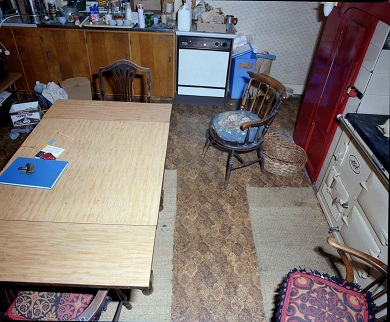
The Kitchen at White House Farm on 12th August
There appeared to be no trace of the woman seen in the kitchen earlier.  On hearing movement upstairs they called to Sheila to make herself known. The officers in the team were wearing open microphones but no recordngs from these these have been disclosed. In the 2002 appeal statements by these officers they shifted their stories to exclude calling to Sheila Cafell, and said they operated in silence using hand signals to communicate. Nevertheless, many note that they thought Sheila was alive in the house.

In particular on 25.02.02 PC Hall changed his account insisting that they made no noise in the house. “In this incident the use of stealth in our approach was employed so as to create as least noise as possible. This was due to the fact that we believed that Sheila may still have been alived and armed. This approach in the farmhouse was completed by handsignals and whispers.” Curiously, he omits a vital passage from his earlier statement of 1985 where he says “I immediately heard a noise upstairs and began to challenge up the stairs I was covering, I was calling to Sheila Bamber to make her whereabouts known to me.”  I think you would agree, that either the raid team were using hand signals and stealth, or they weren’t. It appears that the police would have it both ways, omitting crucial details from statements when it suits their purpose. Perhaps smashing the backdoor in with a sledge hammer and calling up a staircase comes under the guise of “stealth” but that’s not the dictionary deffinition of it.

 There were three staircases at the farm and on ascending the different staircases police found they could not get through from one part of the building to the other side and had to return to the ground floor to ascend the next stair case.

The officers being fearful that Sheila was upstairs and armed the TFG used a mirror to look up the main staircase where they eventually saw the body of June Bamber in the door way of the master bedroom. On climbing the main staircase and entering the bedroom they found Sheila Caffell on her father’s side of the bed where she had shot herself. It was a tragic scene and Sheila’s twin boys were found in their beds shot whilst they slept.

Jeremy Bamber had remained away from the house during the entire time of the siege and sat in a police car, he was distressed and broke down both during the siege and when he was told that he had lost his entire family.

All of the family including the Pargeters, Eatons and Caffell’s were in total disbelief at what had happened. It was hard for them to comprehend, a young mother killing her family and children, something we frequently hear of on the news nowadays. Jeremys uncle, Robert and cousin Ann, must have been worried because Jeremy now owned a large stake in a joint family business, and he also unknowlingly owned half of the land Ann and Peter were farming.  He expressed a wish to sell on some of the estate. David, Ann’s brother found a sound moderator in a cupboard at the farm he says, 3 days after police closed the scene.

Jeremy’s then girlfriend Julie Mugford was “preported for process” by Essex Police and was charged with burglary at Witham Police Station a month after the killings, she reported that Jeremy had told her he had hired a hit-man to kill the family. Jeremy was arrested but released without being charged with the murders. But within a few weeks the forensic scientists had tested the sound moderator found by some of the relatives who inherited the Bamber estate, and Jeremy was arrested and charged with murder at the end of September.
Jeremy Bamber was found guilty by a 10-2 majority at Chelmsford Crown court, he was just 24 years old. There was no forensic evidence connecting Jeremy Bamber to the crime, Mugford’s story had changed from there being a hit man to her suspecting that Jeremy had carried out the killings himself to gain the inheritance, assets of £425,000. The key exhibit was the blood in the moderator (silencer) which was ungroupable but contained an enzyme which corresponded to Sheila’s blood group. At the last appeal it was shown that there was none of Sheila’s DNA inside the moderator.

Jeremy Bamber has had two failed appeals and continues to maintain innocence to this day even petitioning to take a lie detector test for many years, when he eventually did he passed. Jeremy has no mental illness and shows no trace of psychopathy.

The object of this web site http://jeremybamber.org/  is to place into context some of the evidence presented at trial by key prosecution witnesses. All evidence used on this site is drawn directly from case documents (unless otherwise stated) including the statements of those it refers to.

Tuesday, 6 March 2012

Copper+Lawrence killer's father+police='corrupt relationship'

By:Michael Gillard , Laurie Flynn Tuesday 06 March 2012
http://paper.li/thelawmap/1325247377

The failure of the original hunt for the killers of Stephen Lawrence will come under fresh scrutiny today following the emergence of secret Scotland Yard files which reveal police concerns about one of the officers involved in the inquiry.
The police intelligence reports, obtained by The Independent, outline extensive allegations of corruption against John Davidson, a lead detective investigating the racist murder. The files can be made public following the convictions in January, 19 years after the event, of Gary Dobson, 36, and David Norris, 35.
It can also be revealed that details of the officer's alleged criminality were held back from the public and the Lawrence family's legal team.
The Lawrence family last night demanded that the Metropolitan Police explain why it never showed them the files or revealed their existence. Doreen Lawrence said: "Had we known even a scintilla of this in the last 18 years, we would have been shouting it from the rafters."
The Lawrence family has long suspected that corruption played a part in the Met's failure to arrest Dobson, Norris and three other members of a white gang, despite dozens of people coming forward to name them within days of the 1993 fatal stabbing in south-east London. There have been numerous Met internal inquiries and an inquiry by the police watchdog. But vital facts relevant to the Lawrence case have not been made public. The evidence gathered by The Independent reveals that:
* A key investigator in the original botched hunt for the killers was corrupt and engaged in extensive criminal enterprise, according to the secret Met files. Detective Sergeant John Davidson, who interviewed key Lawrence suspects and witnesses within days of the stabbing, was a "major player" in a ring of bent detectives "operating as a professional organised crime syndicate", according to previously unpublished intelligence reports.
* Davidson had corrupt relations with informants, dealt in Class A drugs and "would deal in all aspects of criminality when the opportunities presented themselves", according to the files written by senior anti-corruption officers.
* Davidson is alleged to have admitted that officers had a corrupt relationship with Clifford Norris, the gangster father of murderer David Norris. A police supergrass recently gave evidence under oath at the Old Bailey that Davidson had told him bent cops "looked after old man Norris".
* Anti-corruption officers were aware of the alleged link with Norris during the 1998 Macpherson inquiry, according to new testimony from the former Crown prosecutor on the case, but an internal Met legal memo suggests that the force feared the claim would get out while it was being sued by the Lawrence family.
* John Yates, the former Met Assistant Commissioner who led the investigation into Davidson and his colleagues, can be revealed to have prepared testimony for police corruption proceedings last year, unrelated to Davidson, confirming that "there was a huge appetite to prosecute John Davidson, who we considered then and still do now to have been a major corrupt player of that era".
Davidson never faced criminal charges and was allowed to retire on ill health grounds to run a bar on the Spanish island of Menorca after prosecutors decided there was a lack of corroborating evidence. The detective denies being corrupt, describing the allegations as "devastating and false".
These intelligence files and the previously unreported evidence from recent police corruption proceedings raise serious questions for the Met about whether the Macpherson inquiry – which in 1999 found the force to be "institutionally racist" – was shown the full extent of the allegations against Davidson.
Macpherson found that incompetence, rather than corruption, was to blame for the failure to catch any of the killers, and no officer faced serious disciplinary measures over their role in an investigation whose shortcomings provoked a transformation in British policing which many feel is incomplete.
Lingering suspicions remain that extraordinary lapses – such as the two-week delay before any of the suspects were arrested – cannot be put down to mere procedural shortcomings. At least three of Stephen Lawrence's killers remain at large.
Imran Khan, Doreen Lawrence's solicitor, said: "Doreen Lawrence said after the verdicts that they had achieved only partial justice and wanted the police to pursue the other individuals who were involved. We want the Metropolitan Police – and those who are in a position to do so – to conduct a full inquiry into the allegations The Independent has raised. If there was corruption, the Metropolitan Police needs to uncover it and deal with it, so that those who were under its influence are now free to do and say what they want to say."
"We don't know if there are such witnesses but it still leaves a potential opening. We can't rely on forensic evidence and we now have to look to other lines of inquiry. This is a legitimate and credible line of inquiry. It's important for the family that those leads are followed that could result in prosecution of those who are still at large."
Last night, a member of the Macpherson inquiry's advisory panel confirmed it had suspected that corruption played a role in the failure of the original police investigation and that not all information available had been handed over by the Met. Dr Richard Stone said: "There was a whole lot we were not told. If this is true, it confirms suspicions we had during the inquiry that seemed very likely with David Norris's father around."


Inside the Met's corruption files
Davidson, a hard-bitten cop who began his career as a constable in Glasgow, arrived at the Lawrence investigation within 36 hours of the stabbing.
He dealt with a key informant who had just identified David Norris and others as suspects for the murder– and whose informant file was lost during the murder investigation. Davidson also arrested and interviewed Gary Dobson and carried out the interview of another suspect, Luke Knight.
In the subsequent Macpherson report into the bungled murder inquiry Davidson was strongly criticised as "self-willed and abrasive" and offering "undoubtedly unsatisfactory" evidence. However the inquiry panel concluded: "We are not convinced that DS Davidson positively tried to thwart the effectiveness of the investigation."
But files from "Operation Russia" – the investigation by the Met's anti-corruption unit into bent officers in south London in 1998 – show that detectives believed that John Davidson had long been corrupt, and lend weight to the calls for him to now be questioned.
In 1994, with no one charged with the murder of Stephen Lawrence, Davidson had transferred to the South-East Regional Crime Squad (Sercs) in East Dulwich, London, where corruption with informants was endemic. A group of detectives there was already the target of a secret Met anti-corruption unit known as the Ghost Squad. A new anti-corruption squad was formed in January 1998, CIB3.
Then-Detective Superintendent John Yates, a senior CIB3 officer, targeted Davidson as one of 14 "core nominals" – detectives whose "criminality is extensive and, in essence, amounts to police officers operating as a professional organised crime syndicate", he explained in the case file.
Yates wrote to his superiors in blunt terms in October that year about the evidence he had found against Davidson: "It is now apparent that during his time at East Dulwich Davidson developed a corrupt informant/handler relationship. Their main commodity was Class A drugs, predominantly cocaine, however, Davidson and his informant would deal in all aspects of criminality when the opportunities presented themselves."
This eye-wateringly direct assessment was written at one of the most politically perilous moments in the history of the Met. The Macpherson inquiry was about to finish hearing evidence and begin writing its report.
Yates, the future head of Britain's counter-terrorism policing, seems to have been aware of the wider significance of the evidence he held on Davidson. In a note to senior officers, also written in October 1998, he set out a list of "Difficulties/threats" posed by his investigation into police corruption. One of the "threats" bullet points read: "Lawrence Enquiry [sic] – exposure of ex DS Davidson as a corrupt officer."
The Met did tell the Macpherson inquiry in September 1998 about Operation Russia's interest in Davidson, but said the corruption allegations it was investigating had no connection to the Lawrence murder. The Inquiry asked to be kept fully informed about developments. The Met this week declined to say whether it had shared Yates's October 1998 reports with Sir William Macpherson.
There was one officer however itching to tell Sir William about Davidson – but the Macpherson inquiry would never hear from him.


The police supergrass – and his new evidence under oath
Detective Sergeant Neil Putnam, a colleague of Davidson at East Dulwich and a member of the corrupt cabal, was arrested by Met anti-corruption officers in July 1998, in the middle of the Macpherson inquiry. He immediately agreed to turn "supergrass" against his former comrades.
Putnam said he was "fed up with the lies to cover the lies to cover the lies".
Over a period of four months between July and October 1998, while Macpherson continued to take evidence at his inquiry, Putnam detailed the scale and nature of the corruption that had consumed the East Dulwich branch of the regional crime squad. This included three specific acts of dishonesty he claimed to have carried out with his sergeant Davidson and an informant they managed together: the disposal of stolen watches, handling stolen electrical equipment, and the theft of cocaine from a drug dealer.
Putnam insists he made another, more serious allegation against Davidson: that Davidson had one day casually admitted to him that he was in a corrupt relationship with Clifford Norris – the drug dealing father of David, who murdered Stephen Lawrence.
Putnam has now expanded on this allegation under oath for the first time, during new corruption proceedings at the Old Bailey against other officers from the same crime squad.
Putnam, a born-again Christian who was jailed for his own corruption offences in 1998, told the court four months ago that when he and Davidson had been alone in the office one Sunday, he had asked Davidson about the Lawrence case.
He said: "We were talking and I turned round and said that I felt that it was obvious that the boys were guilty, so obvious something's wrong. And then John suddenly came out with the fact that he'd been dealing with, his exact words were, 'old man Norris'.
"Now I knew that one of the boys was Norris and old man Norris is the dad. John said that he'd given them information. John wasn't precise as to what the information was and John said they'd looked after him, those were the exact words 'they'd looked after him' and then, that there'd been 'a real little earner out of it' and I knew exactly what he meant by 'a real little earner' and it meant that they'd received cash, received money."
Putnam told the court he had known immediately the implication of what his colleague was telling him: "The person we were talking about was Clifford Norris and no one else." He added that he was troubled by the revelation, saying: "I didn't want to know any more. You didn't push the question, it was the culture we were in."
The supergrass told the Old Bailey that he had provided this information to his CIB3 debriefers in the summer of 1998 and they had written the details down in a notebook. Given that his revelations were being made at the height of the Macpherson hearings, where Davidson had already appeared, Putnam said he had been assured this information would be passed to the inquiry and he would be called to give evidence. The call never came.
Putnam told the court that he believed his evidence was "brushed under the table" because the allegation would "blow apart" the Met.
Asked why he was now giving evidence, he replied: "I said it to the police and they did nothing about it. As far as I'm concerned they hid it away, they didn't want it to come out." Putnam had never given evidence under oath about the Lawrence allegation and risked returning to prison for perjury if he was now lying at the Old Bailey.
The officers in charge of debriefing Putnam also gave evidence under oath and denied he had mentioned corrupt links in the Lawrence case. The Met produced five notebooks, which it said covered the entire period of Putnam's debrief and contained no trace of the claim. Putnam believes at least 15 notebooks were used to record his evidence and he was "absolutely certain" the Norris claim was recorded, telling the court: "It was written down."
The Met has admitted mistakes in the way it debriefed the supergrass – specifically that the initial debriefings were not tape-recorded.
Ever since the allegations about Davidson having a corrupt relationship with Clifford Norris became public, Scotland Yard "sources" have tried to downplay Putnam's credibility as a witness. But senior figures at the Yard in fact privately enthused about Putnam's credibility, Met documents now show.
Police intelligence files show that John Yates told his superiors categorically in 1998: "Putnam's value as a witness to the Crown cannot be over-esti
mated. In spite of his criminality he will present as a credible witness thoroughly contrite about what he has done and the shame that this will bring upon him, his family and the MPS [MetropolitanPolice Service]. This has been a consistent thread throughout his debrief."
The same police intelligence report shows that Yates regarded Putnam as "an unremarkable figure – a follower rather than a leader, a grass eater rather than a meat eater, a man desperate to show he was one of the boys – a trait that led him into a spiral of heavy drinking, debt and thus vulnerable to corruption."
Putnam's estranged former wife Gail also gave evidence for the first time, under oath at the Old Bailey, supporting his explosive claims. She told the court that Putnam had confided in her while he was a supergrass that "evidence was withheld for some time because [Davidson] was linked to the father of one of the suspects." She said she was "incensed" the information had not come out before.
Putnam has aired some of his claims about corruption previously – notably in the controversial 2006 Panorama titled "The Boys Who Killed Stephen Lawrence", which broadcast claims that the original Lawrence inquiry was tainted by corruption. But his evidence in October was the first time he has put forward the allegations under oath.
Even then, the Met's position is that its one-time star witness Putnam was not lying but simply "mistaken". The supergrass, however, has received significant support from an unlikely official source, revealed here for the first time.


Crown prosecutor's testimony on 'corrupt' officer
In July 1998, Martin Polaine was a highly regarded CPS barrister in charge of reviewing the case file on the Lawrence murder when he was recruited to a new hand-picked team of prosecutors with the highest security clearance to analyse the Met's secret intelligence on corruption.
Polaine was trusted by anti-corruption bosses and put in charge of reviewing evidence obtained by Operation Russia to see if it was capable of being used in prosecutions against officers, including Davidson.
Describing how he had been regularly updated by CIB3 officers about the debriefing of Putnam, the former Crown prosecutor told the Old Bailey at recent corruption proceedings: "I have a recollection I was told by someone in CIB3 of a link between Clifford Norris and Davidson."
He told the court that when this information was passed to him in late 1998 it was considered "of great significance" and added: "It stuck in my mind ... I recall not being surprised when it was more recently reported that Neil Putnam was speaking of the link."
Polaine's evidence raises the question of whether some of the allegations against Davidson were not made public to prevent further damage to Scotland Yard's reputation at the time of the Macpherson inquiry.
The nightmare scenario for the Met was that Davidson would be found to have thwarted the Lawrence murder investigation. It can now also be revealed that David Hamilton, the Met's head of legal affairs at the time, submitted a witness statement to the recent police corruption proceedings also recalling that there had been "a suspicion of an association or contact between Davidson and the Norris family".
This appears to support a legal memo Hamilton wrote in August 2000 outlining the Met's reluctance to disclose intelligence it held on Davidson – at a time when the force was facing a civil damages claim from the Lawrence family.
Hamilton, then the Met's most senior lawyer, wrote in 2000: "Disclosures relevant to Davidson's contact with the Norris family could have an adverse effect on the Commissioner's position in the ongoing High Court action by Mr and Mrs Lawrence.
"Part of their claim is based on misfeasance in public office and alleges wrongdoing in relation to dealings between police and the Norris family."
The Lawrences were eventually paid more than £300,000 by the Met in an out-of-court settlement.
When approached by The Independent, Polaine – who was disbarred in 2010 as a barrister for "far-reaching errors" in his advice to a Yates-led anti-corruption inquiry in the Cayman Islands – stood by his evidence in court, and declined to comment further.
Last night, Richard Stone, a member of the Macpherson inquiry, described this latest evidence from Polaine and Hamilton as "very disturbing".


Clifford Norris
In 2006, the Lawrence family asked the Independent Police Complaints Commission (IPCC) to investigate Putnam's claims to Panorama that the Met failed to disclose to the Macpherson inquiry what he had told them of a Davidson-Norris link. The police watchdog said it could not find evidence for Putnam's Panorama allegations. The IPCC concluded that Polaine, Putnam and Hamilton had confused Clifford Norris with a different crime squad informant coincidentally called David Norris. But the latter Norris had been murdered in 1991, two years before Stephen Lawrence, and all three witnesses insist there was no confusion.
Davidson declined to meet with the IPCC investigators who were looking into the alleged link to Clifford Norris. The former detective could not be reached via his lawyers or the Police Federation to comment on the latest revelations but he has previously issued a statement strongly denying he was guilty of corruption.
Davidson said: "The first and only time I came into contact with Clifford Norris was in 1994 when, whilst leading an arrest team, I arrested him for offences including firearms and drugs. He was subsequently charged and convicted in relation to these offences. Other than in relation to this arrest, I have had no dealings either directly or indirectly with Clifford Norris.
"I am not corrupt. I did not hamper in any way the investigation into the death of Stephen Lawrence. I am not 'a friend' of, nor did I know, Clifford Norris other than that mentioned above. I would stress the only time I dealt with Clifford Norris was after I had stopped working on the Lawrence investigation."
The former detective also criticised Yates for saying he was corrupt: "I am also very concerned that ... Yates thought it appropriate to condemn me as a corrupt officer."
Clifford Norris meanwhile has denied paying police officers or knowing Davidson. The Macpherson inquiry did hear that a different officer, David Coles, was seen meeting Norris in the late 1980s and receiving a carrier bag containing unknown items. Approached by The Independent recently at his flat above a hardware shop in a seedy area of Ashford, Kent, Clifford Norris said "Fuck off", and slammed the door.


A police force 'in denial'
Scotland Yard now acknowledges that it knew of corruption within Davidson's unit before he was allowed to give evidence to the Macpherson inquiry, and that it subsequently found evidence of Davidson's own corruption – but says it could not find evidence of Davidson having thwarted the Stephen Lawrence murder inquiry.
A spokesman for the Met said: "While there was intelligence of potential corruption within the South East Regional Crime Squad (East Dulwich) no individuals were identified as suspects until Operation Russia began in the spring of 1998. It was not until the arrest of ex-DC Neil Putnam in July 1998 that specific allegations relating to ex-DS John Davidson emerged."
The Met was asked if it had disclosed to Macpherson Yates's belief that Davidson was a key player in a gang of officers "operating as a professional organised crime syndicate".
A Met spokesman replied that the Yard had informed Macpherson of the broader investigation: "We were at a very early stage of the investigation and the allegations were un-corroborated and did not relate to Stephen's murder. However we recognised the significance of Davidson as a witness to the Inquiry and therefore informed them of the investigation."
The Met spokesman added: "Ex-DS John Davidson was subject to an in-depth corruption investigation, during which there was never any evidence of Davidson being involved in corrupt activity within the Stephen Lawrence inquiry or doing anything to thwart that investigation. Had we had such information it would have been determinedly pursued.
"The corruption investigation revealed much intelligence and some evidence of Davidson, and others being involved in corrupt activities, but their actions were unconnected to the investigation into Stephen's death.
"We do not consider that any new or significant information has emerged ... since the IPCC reached their conclusions in 2007. Should any substantive information arise relating to alleged corruption in the original Stephen Lawrence murder investigation it would be seriously considered."
Asked why its own head of legal affairs from 1998, David Hamilton, said in his witness statement to the recent corruption proceedings at the Old Bailey that there had been a "suspicion of an association or contact between Davidson and the Norris family", the Met spokesman replied only: "Inquiries by the MPS and the IPCC have found no evidence of a link between ex-DS John Davidson and the Norris family."
A spokeswoman for the IPCC said: "We are aware of Mr Putnam's claims and were aware of them during our investigation. We are also aware of Mr Polaine's comment ... There is nothing which would change our findings or cause us to look into this matter again – they provide no more to substantiate Mr Putnam's claims than the information we previously had.
"The material in this case is now archived but we have no reason to believe that any Operation Russia material was withheld from the IPCC or the Macpherson inquiry. We were provided with full access to the material. We have no reason to believe that the Macpherson inquiry was not fully aware of allegations involving DS Davidson.